It was August...
Sunflower fields around La Pouyette
...the sunflowers were
blooming,
 and
Van Gogh desperately wanted to capture them
in a series of
12 pictures.
and
Van Gogh desperately wanted to capture them
in a series of
12 pictures.

"I am working with the enthusiasm of a man from Marseilles eating
bouillabaisse,
which shouldn’t come as a surprise to you because I am
busy painting huge sunflowers."
*
Sunflowers, Friendship and Gratitude
Van Gogh began painting the Sunflowers in late summer 1888
and continued into the following year.
The paintings show sunflowers in all stages of life, from full
bloom to withering.
The paintings were considered innovative for their
use of the yellow spectrum,
partly because newly invented pigments made new colours possible.
Because the flowers wilted so quickly, he worked on his
canvases every day.
He painted the series to decorate the room where
Paul Gauguin would stay when he arrived in Arles.
He chose this subject
because his friend had previously admired his paintings of sunflowers
run to seed.
In the end, Vincent executed four sunflower still lifes;
however, he felt only two were good enough to hang in Gauguin’s
bedroom.
He was later to paint three copies of them,
one of which is the
version in the Van Gogh Museum.
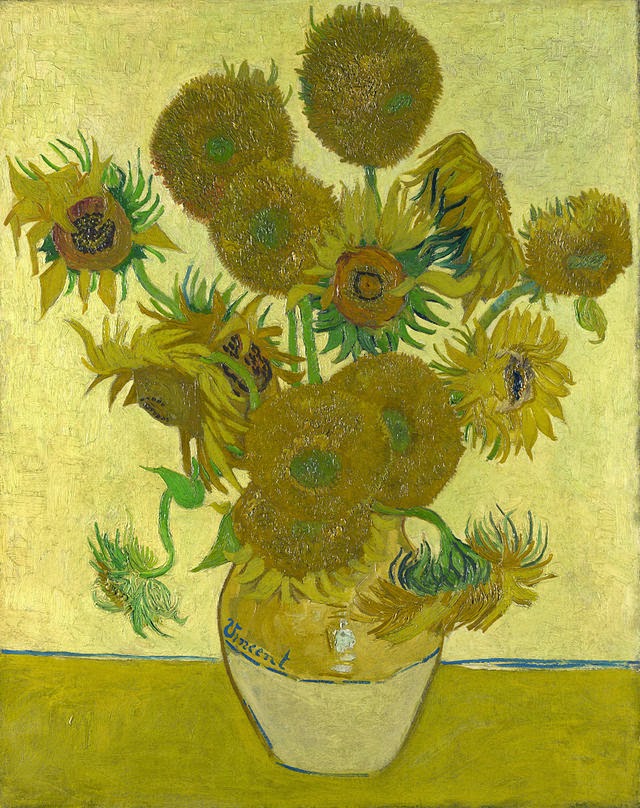
This is one of four paintings of sunflowers dating from August and September 1888.
Van Gogh intended to decorate Gauguin's
room with these paintings in the
so-called Yellow House that he rented
in Arles in the South of France.
He and Gauguin worked there together
between October and December 1888.
The Yellow House 1888,
Van Gogh Museum
Van Gogh wrote to his brother Theo in August 1888:
"I am hard at it,
painting with the enthusiasm of a Marseillais eating bouillabaisse,
which won't surprise you when you know that what I'm at is the painting
of some sunflowers.
If I carry out this idea there will be a dozen
panels.
So the whole thing will be a symphony in blue and yellow.
I am
working at it every morning from sunrise on, for the flowers fade so
quickly. .....
....I am now on the fourth picture of sunflowers....
...This fourth one is a bunch of 14 flowers, against a yellow background,
like a still life of quinces and lemons that I did
some time ago."
"It is a kind of painting that rather changes in character,
and takes
on a richness the longer you look at it.
Besides, you know, Gauguin
likes them extraordinarily.
He said to me among other things -
'That...it's...the flower.'
"You know that the peony is Jeannin's, the hollyhock belongs to Quost,
but the sunflower is somewhat my own."
*
*
Sunflowers (original title, in French: Tournesols)
The earlier series executed in Paris in 1887
depicts the flowers lying
on the ground.
The two Sunflowers in question show two buttons each;
one of them was preceded by a small study,
and a fourth large canvas combines both compositions.
These were Van Gogh's first paintings with
"nothing but sunflowers"
-yet, he had already included sunflowers in still life and landscape earlier.
*
The second set, the initial versions, executed a year later in Arles,
shows
bouquets of sunflowers in a vase. (below)
In the artist's mind both sets were
linked by the name of his friend Paul Gauguin,
who acquired two of the Paris versions.
About eight months later
Van Gogh hoped to welcome and to impress Gauguin again with Sunflowers,
now part of the painted décoration that he prepared for the guestroom of his Yellow House,
where Gauguin was supposed to stay in Arles.
"Now
that I hope to live with Gauguin in a studio of our own,
I want to make
decorations for the studio.
Nothing but big flowers"
The initial versions, August 1888:
First version, turquoise background Second version, royal-blue background
Third version, blue green background Fourth version, yellow background
**
*
The Repetitions, January 1889


repetition of the third version (left) repetition of the fourth version (yellow background) right
replica of the 4th version (yellow green background)
If you hear a voice within you say 'you cannot paint,'
then by all means paint, and that voice will be silenced.
*
*
Sunflowers - facts and myths

(La Pouyette)
Much of the meaning of sunflowers stems from its namesake, the sun
itself.
Wild sunflowers are often photographed with their tall stalks
and bright petals stretched towards the sun.
 (La Pouyette)
This unique behavior,
known
as phototropism, is a motif that has appeared in many ancient myths
and
is viewed as a symbol of loyalty and constancy.
(La Pouyette)
This unique behavior,
known
as phototropism, is a motif that has appeared in many ancient myths
and
is viewed as a symbol of loyalty and constancy.
(La Pouyette)
Sunflowers originated in the Americas, where for centuries
they were cultivated as a valuable food source.
The use of sunflower
images as religious symbols has also been documented in some native
societies.
With the European exploration of the New World, the sunflower
was brought to new areas,
and the flower’s popularity eventually spread
as the rest of the world began to appreciate its beauty and sustenance.
(see/read also remarks)
Artists throughout history have appreciated the sunflower’s unique
splendor,
and those of the Impressionist era were especially fixated on
the flower.
No flower can lift spirits quite like sunflowers
can.
Bright and cheery, bold yet comfortable, the sunflower is a warm
and caring gift.
(La Pouyette)
Gifts of radiant warmth, sunflowers are the happiest of flowers,
and
their meanings include also longevity.
They are unique in their
ability to provide energy in the form of nourishment and vibrance,
an
attribute which mirrors the sun and the energy provided by its heat and
light.
(La Pouyette)
Sunflowers are often associated with truth, loyalty, and honesty.
If you
want to know the truth about something, sleep with a sunflower under
your pillow - and the next day,
before the sun goes down, the truth
should be revealed to you.
The sunflower is considered a flower of
loyalty because day after day,
it follows the sun, from east to west.
In
some folk magic traditions,
it is believed that slipping a bit of
sunflower oil or seeds into someone’s food or drink
will cause them to
be loyal to you.
(from here)
Greek Mythology:
 Clytia, or Clytie was a water nymph,
daughter of Oceanus and Tethys in Greek Mythology. .
She loved Helios.
Clytia, or Clytie was a water nymph,
daughter of Oceanus and Tethys in Greek Mythology. .
She loved Helios.
Helios, having loved her, abandoned her for Leucothea and left her deserted.
She was so angered by his treatment that she told Leucothea's father, Orchamus,
about the affair.
Since Helios had defiled Leucothea, Orchamus had her
put to death by burial alive in the sands.
Clytie intended to win Helios
back by taking away his new love,
but her actions only hardened his
heart against her.
She stripped herself and sat naked, with neither food
nor drink, for nine days on the rocks,
staring at the sun, Helios, and
mourning his departure.
After nine days she was transformed into the
turnsole (which is known for growing on sunny, rocky hillsides),
which turns its head always to look longingly at Helios' chariot of the sun.
The episode is most fully told in Ovid, Metamorphoses
 "Clytie changée en tournesol"
by Charles de la Fosse, 1687-1688
"Clytie changée en tournesol"
by Charles de la Fosse, 1687-1688
*
As time passed - in history, Helios was increasingly identified with the god of light, Apollo.
 Another "myth version":
The story of unconditional love that was never
returned.
Another "myth version":
The story of unconditional love that was never
returned.
Apollo was the son of Zeus, the king of all Gods and Men. Apollo was the
Sun God.
He had a palace in the eastern direction and would ride his
chariot of Gold and Ivory
everyday in the skies from East to West.
In
the evening, he would end his journey at the far sea on the western end
and would come back home on his Golden boat.
He was admired by one and all as he was believed to spread love and life
to every being.
He was known for his youthful and manly beauty.
He had
Golden hair and was the most handsome person that anyone had come
across.
He was loved by all and a water nymph called Clytie was immensely in
love with Apollo.
She would watch him with unblinking eyes as he moved
across the sky.
He looked all the more handsome to Clytie.
Unfortunately, Apollo ignored Clytie and never returned her love.
Apollo
was in love with Daphne, the beautiful daughter of a water God, who did not return his love.
When Apollo
tried to forcefully convince Daphne, she asked her father to help her.
He in turn, turned her into a plant. Apollo was heartbroken and his
sorrow knew no bounds.
Clytie continued to watch Apollo as he passed through the sky.
She sat
on a rock for nine days without food and water and just kept looking at
Apollo as he passed in the sky.
Eventually, she was turned into a
flower, which came to be known as the Sunflower.
It is believed that even to this day,
the Sunflower keeps looking at the sun from the moment the sun rises till he sets.
here
The Sunflower
Who can resist it's beauty?
Who can explain to me it's nature
To follow the Sun, until he fades away into the night
and again waiting for a new day, prepare for a light.
Turned on the south,
with her head held high
she greets the Apollo, god of the son,
while his sun rays caress her trough the sky.
From sunrise to sunset,she follows her love
making sure not to take her eyes off him
not even for a second of time,
perennially in love with her love, sun "divine"
That is her curse of unrequited love,
the curse of great legend
and story of hear heart, blinded by lust,
like a lost man with his eyes in a dust.
She was blinded by love
that was so honest and so pure,
yet so far away and so unfathomable,
and it was her illness without cure.
here

Epilog
Sunflowers, Friendship, Gratitude and Rejection
When Gauguin agreed to visit Arles,
Van Gogh hoped for friendship and
for his utopian idea of a collective of artists.
In anticipation, that
August he painted sunflowers.
After repeated requests, Gauguin finally arrived in Arles on 23 October.
During November, the two painted together.
Gauguin painted Van Gogh's
portrait:
The Painter of Sunflowers
Portrait of Vincent van Gogh, 1888, Paul Gauguin
Van Gogh Museum, Amsterdam.
and - uncharacteristically -
Van Gogh painted some pictures from memory (deferring to Gauguin's ideas in this)
The two visited Montpellier that December, and viewed works in the Alfred Bruyas collection by Courbet and Delacroix in the Musée Fabre,
but their relationship began to deteriorate. Van Gogh greatly admired
Gauguin, and desperately wanted to be treated as his equal, but Gauguin
was arrogant and domineering, a fact that often frustrated Van Gogh.
They quarreled fiercely about art; Van Gogh felt an increasing fear that
Gauguin was going to desert him, as a situation he described as one of
"excessive tension" reached crisis point.
Mirror-image self portrait with bandaged ear, 1889
Courtauld Institute Galleries, London
The precise chain of events that led to the celebrated incident of van
Gogh slicing off his ear is not known reliably in detail. The only
account attesting a supposed earlier razor attack on Gauguin comes from
Gauguin himself some fifteen years later, and biographers agree this
account must be considered unreliable and self-serving.
However, it does seem likely that, by 23 December 1888, van Gogh had
realized that Gauguin was proposing to leave and that there had been
some kind of contretemps between the two.
That evening, van Gogh severed his left ear (either wholly or in part;
accounts differ) with a razor, inducing a severe haemorrhage.
He bandaged his wound, wrapped the ear in paper, and delivered the
package to a brothel frequented by both him and Gauguin, before
returning home and collapsing. He was found unconscious the next day by
the police and taken to hospital. The local newspaper reported that van Gogh had given the ear to a prostitute with an instruction to guard it carefully. In Gauguin's later account, he implies that—in fact—van Gogh had left the ear with the doorman as a memento for Gauguin.
During the initial few days of his treatment, van Gogh repeatedly asked
for Gauguin, but Gauguin stayed away. Gauguin told one of the policeman
attending the case, "Be kind enough, Monsieur, to awaken this man with
great care, and if he asks for me tell him I have left for Paris; the
sight of me might prove fatal for him."
Gauguin wrote of Van Gogh, "His state is worse, he wants to sleep with
the patients, chase the nurses, and washes himself in the coal bucket.
That is to say, he continues the biblical mortifications."
Theo was notified by Gauguin, and visited Van Gogh, as did both Madame
Ginoux and Roulin. Gauguin left Arles, and never saw Van Gogh again.
*
Vincent Willem van Gogh
(30 March 1853 – 29 July 1890)
Post-Impressionist Dutch painter
whose work - notable for its rough beauty, emotional honesty, and bold color
had a far-reaching influence on 20th-century art.
Self-Portrait with Straw Hat, Paris, Winter 1887/88
Metropolitan Museum of Art,
"I am still far from being what I want to be,
but with God's help I shall succeed."
*
 Ah Sunflower, weary of time,
Who countest the steps of the sun;
Seeking after that sweet golden clime
Where the traveller's journey is done;
William Blake
Ah Sunflower, weary of time,
Who countest the steps of the sun;
Seeking after that sweet golden clime
Where the traveller's journey is done;
William Blake

I put my heart and my soul into my work,
and have lost my mind in the process.
*
*
*
Remarks:
Van Gogh:
Both repetitions of the 4th version are no longer in their
original state.
In the Amsterdam version a strip of wood was added at
the top - probably by Van Gogh himself.
The Tokyo version, however, was
enlarged on all sides with strips of canvas, which were added at a later
time -
The series is perhaps his best known and most widely reproduced.
In
recent years, there has been debate regarding the authenticity of one of
the paintings,
and it has been suggested that this version may have
been the work of Emile Schuffenecker
or of Paul Gauguin.
Most experts, however, conclude that the work is genuine
Sunflowers - facts and myths:
Its story has the historical and continental sweep of a Hollywood epic,
from the pre-European Americas to Tsarist Russia and back again.
From North America travel to the Old World and back – and back again
-
in their centuries old journey to become the plant we know today.
They were probably one of the first crops to be grown in the Americas.
It was not until the eighteenth century that the sunflower gained huge
popularity as a cultivated plant and the person we have to thank for
that is perhaps not the first who might spring to mind. Peter the Great
of Russia went on one of his many trips and landed up in Holland.
There, he became so enamored of the giant flower that he took seeds back
to Russia where the people were no doubt nonplussed by it – at least to
begin with. During Lent, the Russian Orthodox Church forbad its
adherents from consuming oil. However, the oil of the sunflower was not
on the prohibited list and the Russian people jumped on
Peter’s
bandwagon wholeheartedly.
By the third decade of the nineteenth century
sunflower oil was manufactured in Russia
on a large and highly
lucrative commercial scale.
read more/all here
Remains of sunflowers dating back 4,600 years have been found in Mexico.
In the 1500s, Spanish explorers took sunflowers back to Europe with
them,
and the species has spread around the world since then.
Sunflower was a common crop among American Indian tribes throughout
North America.
Evidence suggests that the plant was cultivated by
American Indians in present-day Arizona
and New Mexico about 3000 BC.
Some archaeologists suggest that sunflower may have been domesticated
before corn.
info here


2.jpeg)
.jpg)


