
The use of monograms has a very long history.
Human beings were using monograms
as a means of identification before they used written language.
In ancient times, monograms were used to sign art works or coins.
In the middle ages their use spread widely as a signature.
It's important to remember that most kings and emperors
were not able to write or even to sign their own name!
Neither Charlemagne (Karl der Grosse) nor Théodoric, king of the Wisigoths,
were able to write and instead used monograms.
In order to signify power, monograms had to be formal and beautiful
thus elaborate models were conceived by calligraphers (1)

As far back as the 18th Century,
it became common to mark linens with the initials of their owner,
largely in order to identify them as laundering was a collective, communal task.
It was not uncommon for whole villages to participate all at once in the laundering of their linens.
These initials were more often than not embroidered in red
as madder was the most common, most durable and the least expensive dye available.
Initially the style of letters used was Gothic or Roman. (1)

However embroideresses found these styles too limited for the expression of their talent,
so they began to invent new and more sophisticated styles
that added ornament and flourishes to their whitework embroidery.

*
Learning to Stitch Monograms
Starting in the mid-19th century in certain continental countries
most girls were taught at school to sew and embroider.
A distinction was made in marking linens between utilitarian work made with "point de marque"
and white embroidery, the latter was a means of not only embellishing the piece
but also a manner of proving the talent, refinement and social stature of the woman.
Young girls generally began their apprenticeship in sewing and embroidery
at the tender age of five or six years old,
and at 14 years of age they would begin the preparation of their "trousseau."
(in German "die Aussteuer - Mitgift")
The trousseau comprised not only the marriage sheet,
but all the linens they would need for married life.
Sometimes they started by embroidering only one letter,
the one of their own name as the identity of their future husband was still unknown. (1)
*

(2)
When I was 6 years old, I've learned at school all kind of "Handarbeit",
needlework, knitting, crocheting,
and - very important - monogram embroidery for the trousseau.
It was a MUST for every girl to learn this as early as possible.
Everybody of us had a "Sticktuch"- a sampler,

(3)
unfortunately I've lost mine......over the years ... :-(
But now let's start with the ABC....with the first part of it
showing some monograms from
A to J
on old linen and hemp from
mid-19th century (1850's) to early 20th century (1920-30's),
all selected from my own stock and collection
A

*


*

A simple embroidered crown symbolized nobility in Europe.
It can be accompanied by letters or more sophisticated adornments
such as a coat of arms or the family's motto (see also monogram CC)
The continental aristocracy (except in Germany) rarely used three letter monograms
as they preferred to use either a crown with their initials below or their coat of arms. (1)

*

AB - French chemise in hemp

*

AJ - German kitchen towel
*

AR - French hemp 'Nappe de vendange'
*

*

*
B

Detail of a French linen Drap
living now happily in Trish's house TROUVAIS
here
*


BG - German man's shirt in hemp
*

French hemp sheet

*

*


*
C


*

CCB - French Drap and 2 pillow cases, made of the finest linen
*

CB - German hemp chemise
*

CB - French linen over sheet
but....with a bit of fantasy... it could be also read GB...
*
D

*

DX - French hemp sheet
*

DF - French linen damask napkins

*

CD - French lady's chemise - night shirt, in fine linen
*

CD - French linen damask napkin

*

CD - French Drap in fil de lin - over sheet in fine linen

*

French guest towel

*

*

*

*

DR - French DRAP in very fine linen

*
E

*

EB - German linen damask napkins

*

French linen sheet

*

EB - French linen damask napkin
*
F

FE - German hand towel
*

FA- French large hemp towel from a manor house
*

AF - French 'serviette de vendange' in fine linen
*

*

*

*
G

GV - French chemise in hemp
*

*

*

now at TROUVAIS here
*

*
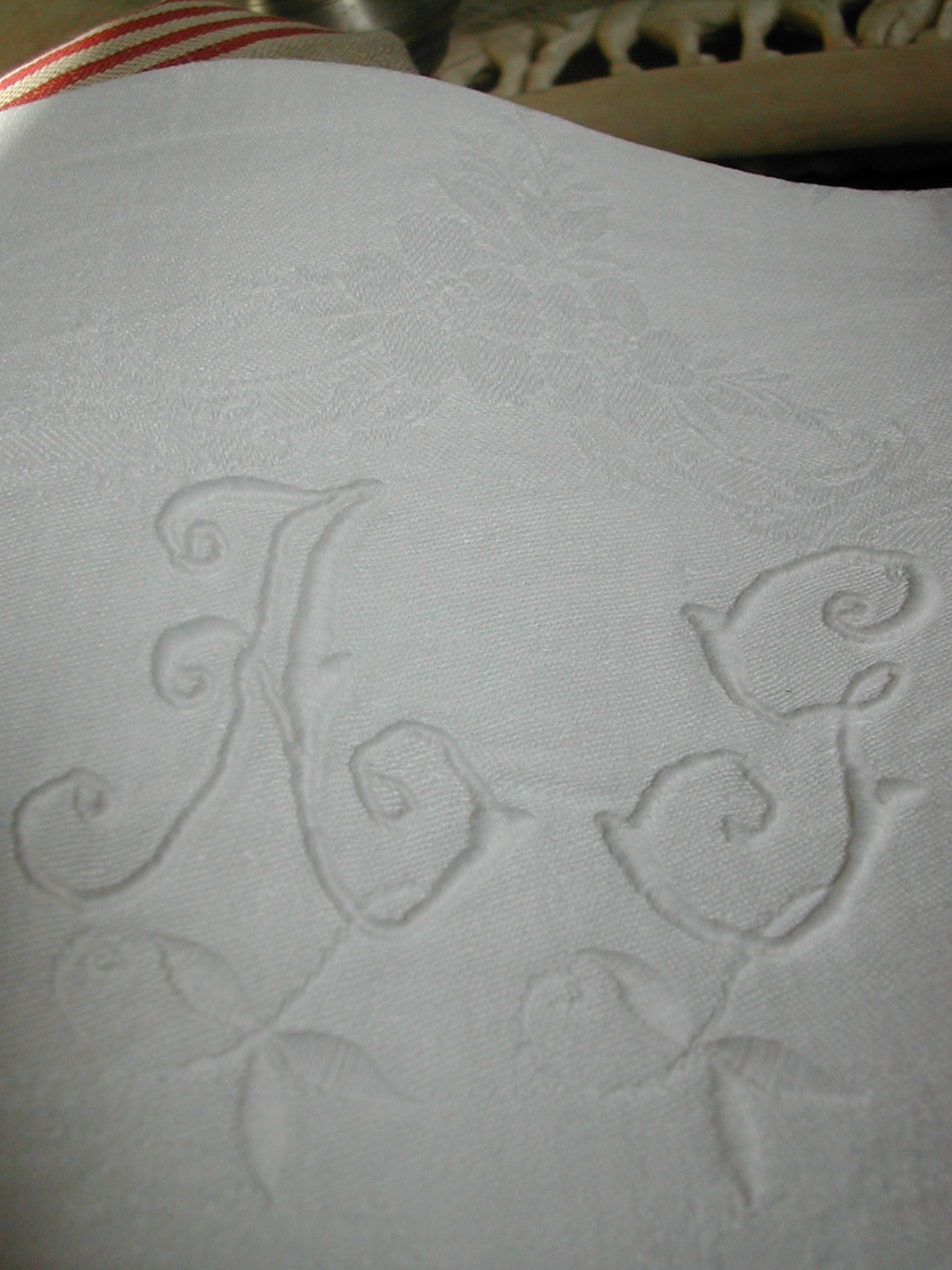
AG - French linen damask napkin
*

GD - French guest towel
*

BG - French linen damask napkin
*

*
H

HL - Set of 16 napkins and a table cloth of banquet size
silk-linen damask of superb quality

*

*

HG or HC - French linen/cotton country napkin
*
I

*

Pair of vintage hemp sacks
*
J

*

*

JG - French linen damask napkins

*

French linen damask napkin
*

*

*

....will be continued with monograms from K to Z...
...part 2 - next post
*
see also my post about monogrammed French linen Draps (over sheets)
here
For any further info or inquiry please contact me
*
*
* Oh - by the way....
HAPPY BIRTHDAY !

to
Fats Domino
born February 26, 1928, in New Orleans


