


More Lavender is coming into full flower....


...here the lavender 'embraces' a Louis XIV. lime stone finial from the mid-18th century

for example...
with an early 19th century French cast iron urn, ca. 1820-30
with an early 19th century French cast iron urn, ca. 1820-30
still in its original condition, it was never over-painted in later times
But - to get the right color of the linen - I need daylight! No flash or artificial light, if possible.
.
A suitable 'spot' in soft evening light, not to bright..probably just right.... ...

an old ladder from the 19th century, a bit "krumm und schief" ('lopsided and crooked')
...but I love it!

certainly made by a local artisan or even by the farmer himself

For me it is like a 'sculpture', and... these beautiful old rusted fixings!

Chanvre - pure hemp, around 1850's
By mixing dye products I tried to get a nice raspberry color
like....
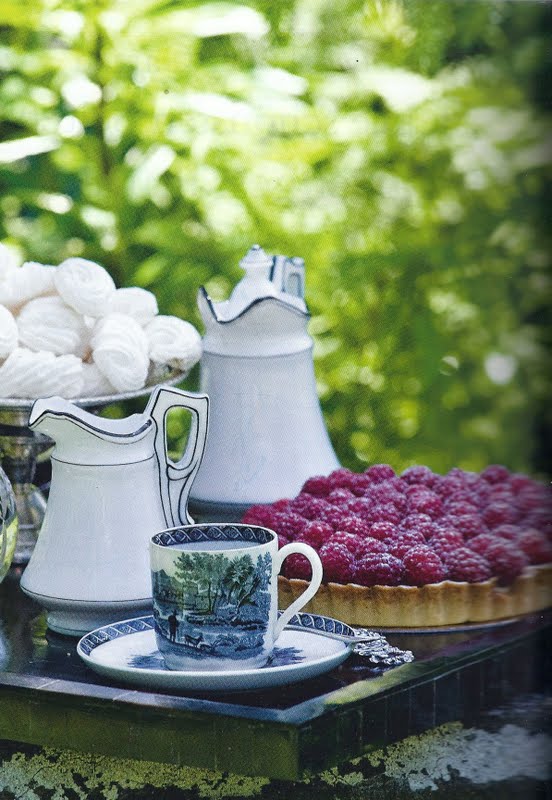
here on the tart
(this image is from the German magazine Wohnen Traeume 2009) 
- different position -


... same kind of old patches and repairs on this Trousseau-flower-sack, dating 1860
...and on this one certainly with heart and soul. and tears!


but back to the French 'raspberry'..hemp..

this image shows the color nearly correct....

A genuine old German grain sack from my large collection
(will write a post about these famous German grain sacks - sometime in the future)


*


*

just love old chipped paint... and wood... and hinges... and handles... and......


French linen-damask napkins and a German mangle cloth


mangle cloth 1910-20

Another German grain sack and mangle cloth with blue stripes
*
*

Linen sheet with center seam, dyed in a nice faded blue
I was aiming for an authentic old-looking 18th century blue...

perfect as a table cloth either inside - or out-door
Now - how to display?

Here with two 19th century Italian storage jars

from my jar-collection
or....

with yellow ones - also 19th century Italian storage jars...or?.......so many ideas...

...Oskar appeared....


His Highness is just mad about old farmers linen! Like me....!
*
Still changing, playing with shapes and colors ..

and in the end - just simple! Which I like most...
here with a pillow made from a 19th century German grain sack in hemp, using the inside
or with a "little horse"

from a vintage German grain sack
Normally I only look for pieces up to the 1920's, latest! But I liked the design of this horse with the blue stripe
*

on top Chanvre hemp, the other one in pure linen,
this image shows clearly the different weave and texture

again: different light - different color
-actually I love this kind of light sea-color! Have to experiment with dyes to get it.....-

*


pure hemp - linen-hemp-mix - pure linen
different weave - different texture
French, from mid- to late 19th century,
all dyed by myself during the last few weeks , trying all kind of different color tones and nuances
all dyed by myself during the last few weeks , trying all kind of different color tones and nuances


*


Original and genuine Germain grain sacks with blue stripes, have a herring bone weave at the outside.
For upholstery and pillows I use mainly the inside,
I prefer the plain coarse weave and the softer color of the blue.
*
And last but not least...
A "little" monogram:

French Drap - over sheet - in fil de lin (fine linen) from the 19th century
with hand stitched center seam and hem.
The hand embroidered monogram is later and dates from the first half of 20th century,
and, because of the design it could be even embroidered in the 1950's.
Dyeing this linen, I tried to get a natural tone of beige, it turned out in a rather pleasing kind of sand color.
Monogram size: 10,5" high by 9,5" wide


these images are showing the size and proportion of the monogram
which is actually not all that "little"!
(sorry, but I haven't got the time to iron the linens again for the 'photo-session')


*

I hope that you all enjoy this 'little tour' of Old Linen and Lavender

