Showing posts with label Oscar Peterson. Show all posts

Friday, 14 December 2012

O Christmas Tree - Oh Tannenbaum...


...wie treu sind deine Blätter!
Du grünst nicht nur
  zur Sommerzeit,


Nein auch im Winter, wenn es schneit.
Oh Tannenbaum, oh Tannenbaum,
wie treu sind deine Blätter!

*
***
****
******
**********
*
*


*
***
****
*****
********
*
*

While it is clear that the modern Christmas tree originates in Renaissance and early modern Germany,
there are a number of speculative theories as to its ultimate origin.


It is frequently traced to the symbolism of evergreen trees in pre-Christian winter rites,
especially with the story of the Donar Oak and Saint Boniface.

According to the Encyclopædia Britannica:
"The use of evergreen trees, wreaths, and garlands to symbolize eternal life was a custom of the ancient Egyptians, Chinese, and Hebrews. Tree worship was common among the pagan Europeans and survived their conversion to Christianity in the Scandinavian customs of decorating the house and barn with evergreens at the New Year to scare away the devil and of setting up a tree
for the birds during Christmastime."

Alternatively, it is identified with the "tree of paradise" of medieval mystery plays that were given on 24 December, 
the commemoration and name day of Adam and Eve in various countries. 
In such plays, a tree decorated with apples (to represent the forbidden fruit) 
and wafers (to represent the Eucharist and redemption) was used as a setting for the play. 
Like the Christmas crib, the Paradise tree was later placed in homes. 
The apples were replaced by round objects such as shiny red balls.


*
***
****
******
*********
*************
*


THE CHRONOLOGICAL HISTORY OF THE CHRISTMAS TREE


St. Boniface Story
Why do we have a decorated Christmas Tree? In the 7th century a monk from Crediton, Devonshire, went to Germany
to teach the Word of God. He did many good works there, and spent much time in Thuringia,
an area which was to become the cradle of the Christmas Decoration Industry.
Legend has it that he used the triangular shape of the Fir Tree to describe the Holy Trinity of God the Father, Son and Holy Spirit. The converted people began to revere the Fir tree as God's Tree, as they had previously revered the Oak. By the 12th century it was being hung, upside-down, from ceilings at Christmastime in Central Europe, as a symbol of Christianity.
The first decorated tree was at Riga in Latvia, in 1510.
In the early 16th century, Martin Luther is said to have decorated a small Christmas Tree
with candles, to show his children how the stars twinkled through the dark night.

*
In the mid 16th century, Christmas markets were set up in German towns,
to provide everything from Christmas presents,


...food and more practical things such as a knife grinder to sharpen the knife to carve the Christmas Goose!
At these fairs, bakers made shaped gingerbreads and wax ornaments for people to buy as souvenirs of the fair,
and take home to hang on their Christmas Trees.


   "Eine Weihnachtszeitung für 1852"
from a German Christmas magazine for 1852

***


The Christmas Market, Berlin 
by Franz Skarbina,  painted in 1892
A bustling Christmas market on a cold and wintry day in Berlin

*
This traditional Christmas-markets are still taking place
in nearly every German village and town......

.....like the Nürnberger Christkindlesmarkt.....


....Germany's most famous Christmas market


Despite intense investigations carried out by several historians and people interested in local history, 
the origins of the Nürnberger Christkindlesmarkt are unknown. 
The oldest piece of evidence relating to it is a box made of coniferous wood. 
On the bottom can be found the following inscription: 
“Regina Susanna Harßdörfferin from the virgin Susanna Eleonora Erbsin (or Elbsin) 
sent to the Kindles-Marck in 1628. 
The box is currently in the possession of the Germanic National Museum in Nuremberg.
read more    here

*
**
*****
*
*

But back to the History of the Christmas Tree:

The best record we have is that of a visitor to Strasbourg in 1601.
 He records a tree decorated with "wafers and golden sugar-twists (Barleysugar) and paper flowers of all colours".
The early trees were biblically symbolic of the Paradise Tree in the Garden of Eden.
The many food items were symbols of Plenty, the flowers, originally only red (for Knowledge) and White (for Innocence).


Illustration by Max von Schenkendorf (1783-1817)

*
***
*****

 
Tinsel
Tinsel was invented in Germany around 1610. At that time real silver was used, and machines were invented which pulled the silver out into the wafer thin strips for tinsel. Silver was durable, but tarnished quickly, especially with candlelight. Attempts were made to use a mixture of lead and tin, but this was heavy and tended to break under its own weight so was not so practical. So silver was used for tinsel right up to the mid-20th century.


The First English Trees
The Christmas Tree first came to England with the Georgian Kings who came from Germany.
At this time also, German Merchants living in England decorated their homes with a Christmas Tree. 
The British public were not fond of the German Monarchy, so did not copy the fashions at Court,
 which is why the Christmas Tree did not establish in Britain at that time. A few families did have Christmas trees however, probably more from the influence of their German neighbours than from the Royal Court.
The decorations were Tinsels, silver wire ornaments, candles and small beads. All these had been manufactured in Germany and East Europe since the 17th century. The custom was to have several small trees on tables, one for each member of the family, with that persons gifts stacked on the table under the tree.


The Victorian and Albert Tree
In 1846, the popular Royals, Queen Victoria and her German Prince, Albert, were illustrated in the Illustrated London News.
They were standing with their children around a Christmas Tree.


  The Queen's Christmas tree at Windsor Castle published in the Illustrated London News, 1848,
and republished in Godey's Lady's Book, Philadelphia in December 1850.


Unlike the previous Royal family, Victoria was very popular with her subjects, and what was done at Court immediately became fashionable - not only in Britain, but with fashion-conscious East Coast American Society.
The English Christmas Tree had arrived!
Decorations were still of a 'home-made' variety. Young Ladies spent hours at Christmas Crafts, quilling snowflakes and stars, sewing little pouches for secret gifts and paper baskets with sugared almonds in them. Small bead decorations, fine drawn out silver tinsel came from Germany together with beautiful Angels to sit at the top of the tree.
Candles were often placed into wooden hoops for safety.

*
Mid-Victorian Tree

In the 1850's Lauscha 
began to produce fancy shaped glass bead garlands for the trees, and short garlands made from necklace 'bugles' and beads. These were readily available in Germany but not produced in sufficient quantities to export to Britain. The Rauschgoldengel was a common sight. Literally, 'Tingled-angel', bought from the Thuringian Christmas markets, and dressed in pure gilded tin.
The 1860's English Tree had become more innovative than the delicate trees of earlier decades.
Small toys were popularly hung on the branches, but still most gifts were placed on the table under the tree.
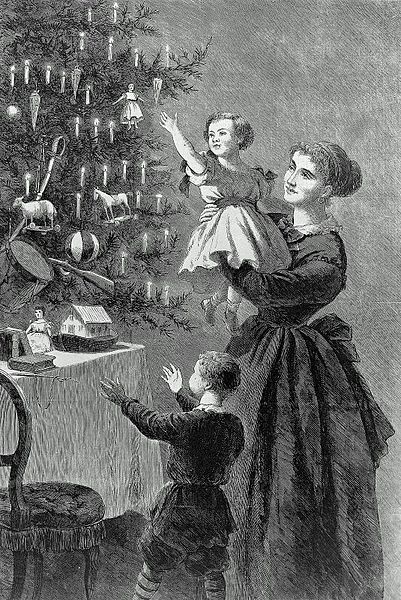
   Illustration for Harper's Bazaar, published 1 January 1870.

Around this time, the Christmas tree was spreading into other parts of Europe. The Mediterranean countries were not too interested in the tree, preferring to display only a Creche scene. Italy had a wooden triangle platform tree called as 'CEPPO'.
This had a Creche scene as well as decorations.
The German tree was beginning to suffer from mass destruction! It had become the fashion to lop off the tip off a large tree
to use as a Christmas Tree, which prevented the tree from growing further.
Statutes were made to prevent people having more than one tree.
Just as the first trees introduced into Britain did not immediately take off, the early trees introduced into America
by the Hessian soldiers were not recorded in any particular quantity.
The Pennsylvanian German settlements had community trees as early as 1747.

America being so large, tended to have 'pockets' of customs relating to the immigrants who had settled in a particular area, and it was not until the communications really got going in the 19th century, that such customs began to spread. Thus references to decorated trees in America before about the middle of the 19th century are very rare.
By the 1870's, Glass ornaments were being imported into Britain from Lauscha, in Thuringia. It became a status symbol to have glass ornaments on the tree, the more one had, the better ones status! Still many home-made things were seen.
The Empire was growing, and the popular tree topper was the Nation's Flag, sometimes there were flags of the Empire
and flags of the allied countries. Trees got very patriotic.
They were imported into America around 1880, where they were sold through stores such as FW Woolworth. They were quickly followed by American patents for electric lights (1882), and metal hooks for safer hanging of decorations onto the trees (1892)

*

The American Tree
In America, Christmas Trees were introduced into several pockets - the German Hessian Soldiers took their tree customs in the 18th century. In Texas, Cattle Barons from Britain took their customs in the 19th century, and the East Coast Society
copied the English Court tree customs.
Settlers from all over Europe took their customs also in the 19th century. Decorations were not easy to find in the shanty towns of the West, and people began to make their own decorations. Tin was pierced to create lights and lanterns to hold candles which could shine through the holes. Decorations of all kinds were cutout, stitched and glued. The General Stores were hunting grounds for old magazines with pictures, rolls of Cotton Batting (Cotton Wool), and tinsel, which was occasionally sent from Germany or brought in from the Eastern States. The Paper 'Putz' or Christmas Crib was a popular feature under the tree, especially in the Moravian Dutch communities which settled in Pennsylvania.

*
**
****
*******
**********
*
*


Choosing the Christmas Tree

 
Father and son venture out into the wintry woods to choose a Christmas tree.
By F. Kruger.

Franz Kruger painted this festive scene in the first half of the 19th century.
Kruger was a German artist who was born in Dessau in 1797, and died in Berlin in 1857.
Better known for his many portraits of German royals and aristocracy,
Kruger was, nonetheless, a competent landscape artist and genre painter,
as we can see here, in this old-fashioned Christmas holiday scene.

*
**
***
*****
*******
*
*

A few more facts:

Germany is credited with starting the Christmas tree tradition as we now know it in the 16th century when devout Christians brought decorated trees into their homes. Some built Christmas pyramids of wood and decorated them with evergreens and candles if wood was scarce. It is a widely held belief that Martin Luther, the 16th-century Protestant reformer,
first added lighted candles to a tree. Walking toward his home one winter evening, composing a sermon,
he was awed by the brilliance of stars twinkling amidst evergreens. To recapture the scene for his family,
he erected a tree in the main room and wired its branches with lighted candles.


It is not surprising that, like many other festive Christmas customs, the tree was adopted so late in America.
To the New England Puritans, Christmas was sacred. The pilgrims's second governor, William Bradford, wrote that he tried hard to stamp out "pagan mockery" of the observance, penalizing any frivolity. The influential Oliver Cromwell preached against "the heathen traditions" of Christmas carols, decorated trees, and any joyful expression that desecrated "that sacred event."
 In 1659, the General Court of Massachusetts enacted a law making any observance of December 25 (other than a church service) a penal offense; people were fined for hanging decorations. That stern solemnity continued until the 19th century, when the influx of German and Irish immigrants undermined the Puritan legacy.

By the 1890s Christmas ornaments were arriving from Germany and Christmas tree popularity was on the rise around the U.S. It was noted that Europeans used small trees about four feet in height, while Americans liked their Christmas trees to reach from floor to ceiling.

 *

In the early 19th Century, 
the custom became popular among the nobility and spread to royal courts as far as Russia and Austria.
In France, the first Christmas tree was introduced in 1840 by the Duchess d'Orleans.


In Britain, the Christmas tree was introduced in the time of the personal union with Hanover, by George III's Queen Charlotte of Mecklenburg-Strelitz in the early 19th century, but the custom hadn't yet spread much beyond the royal family. Queen Victoria as a child was familiar with the custom and a tree was placed in her room every Christmas. In her journal for Christmas Eve 1832, the delighted 13-year-old princess wrote, "After dinner… we then went into the drawing-room near the dining-room… There were two large round tables on which were placed two trees hung with lights and sugar ornaments. All the presents being placed round the trees…"

  In 1847, Prince Albert wrote:
"I must now seek in the children an echo of what Ernest (his brother) and I were in the old time,
of what we felt and thought; and their delight in the Christmas-tree is not less than ours used to be".

 read    here

*
  In Denmark a Danish newspaper claims that the first attested Christmas tree was lit in 1808
by countess Wilhemine of Holsteinborg. It was the aging countess who told the story of the first Danish Christmas tree
to the Danish writer Hans Christian Andersen in 1865.
He had published a fairy-tale called The Fir Tree in 1844, recounting the fate of a fir-tree being used as a Christmas tree.


Dancing round the candlelit tree


 'Glade Jul' by Viggo Johansen, 1891

Dancing around a beautifully decked out Christmas Tree lit by dozens of twinkling candles, the children in Johansen Viggo's painting seem to be having a lot of fun. Painted in 1891, Viggo has perfectly captured a joyful family scene
that gives us a glimpse into family life at the end of the nineteenth century.
Viggo Johansen (1851-1935) was a Danish artist who painted with the Skagen Painters,
a group who met each year in the north of Jutland. Viggo exhibited in Paris from 1885, and he was greatly influenced by the work of the Impressionists, particularly that of Claude Monet. This influence is very apparent in much of his work from this period.

 *
**
***
****
******
*
*

Germany - 18th to early 20th centuries

 By the early 18th century, the custom had become common in towns of the upper Rhineland

 but it had not yet spread to rural areas. 

Wax candles, expensive items at the time, are found in attestations from the late 18th century


Along the lower Rhine, an area of Roman Catholic majority, the Christmas tree was largely regarded as a Protestant custom.
As a result, it remained confined to the upper Rhineland for a relatively long period of time. The custom did eventually gain wider acceptance, beginning around 1815, by way of Prussian officials who emigrated there following the Congress of Vienna.


In the 19th century,
the Christmas tree was taken to be an expression of German culture and of Gemütlichkeit,
especially among emigrants overseas.

 
"Under the Christmas tree" at Wallsee, Germany, 
newspaper illustration, 1916

*
A decisive factor in winning general popularity was the German army's decision to place Christmas trees in its barracks
and military hospitals during the 1870-1871 war. Only at the start of the
20th century did Christmas trees appear inside churches, this time in a new brightly lit form.


  "The German Christmas tree" (Der deutsche Weihnachtsbaum)
in a field hospital in Versailles after the Franco-Prussian war, 1871

and...

...a "simple" Christmas tree
made by German Soldiers in Afghanistan in 2010

*
**
***
****
*
Back to the 'past'.....


The tree was traditionally decorated with edibles such as apples, nuts or dates.
In the 18th century, it began to be illuminated by candles.


*
****

 
  An angel or star may be placed at the top of the tree,
to represent the host of angels or the Star of Bethlehem from the Nativity.


  (1920's - from my family)

***
*

 
Hedwig Mechle-Grosmann, um 1900

*


An artistic "21th Century" Christmas tree by Kymberley Fraser

here

*


2


***
**
*
'Quiet Christmas' 


Stille Weihnacht. Tonzeichnung von Th. Volz  
 Künstler-Postkarte der Familienzeitschrift "Das Buch für Alle".


*
***
*

"Christmas-Tree"- music


by Franz Liszt

and

Oscar Peterson


*
**
***
*****
*******
*

to be continued in my next post.....
...with the history of German Christmas-tree-decoration,


....antique and vintage.....

*
***
*

In the meantime please visit Loi's blog:  Tone on Tone
here


Loi's recent post....


"Our Christmas Tree"
is wonderful!
And his collection of antique and vintage pieces - stunning!

http://toneontoneantiques.blogspot.fr/

*
**
***
*****
*******
*
*


 sources of some text and images/illustrations:
some extracts from

THE CHRONOLOGICAL HISTORY OF THE CHRISTMAS TREE:

 by Countess Maria Hubert von Staufer

 http://www.christmasarchives.com/trees.html  

christmas markets: 

http://www.nikolaus-weihnachten.de/weihnachtsmotive/weihnachtsmarkt-bei-nacht.html

Monday, 6 February 2012

A Fantasy Dinner for 12...


 The theme for the February 'By Invitation Only' post:

"A fantasy dinner given by you & your husband/significant other"
initiated by our dear blogger friend,  Marsha  from   Splenderosa

We have to invite 10 well-known people, living or dead, to be our guests.
We have to tell who they are and where we will hold this dinner party.


To get organized - first the location.

I would prefer to hold this event at our place,

set-up in the garden
this 3,80 meters long by 1,10 meters wide table  -  just the perfect size to seat Twelve (without Oscar!).
 Draped with a large linen tablecloth, decorated with candles and candelabras, etc....
it would be a kind of a "Fête champêtre"

A fête champêtre was a popular form of entertainment in the 18th century,particularly at the French court.  While the term is derived for the French expression for a "pastoral festival" or "country feast" and in theory was a simple form of entertainment in practice, at least in the 18th century, a fête champêtre was often an elegant form of entertainment involving on occasion whole orchestras hidden in trees.

But if it rains ????
Unfortunately our dining table in the house, also a rather large table,
is only comfortable to seat eight.

So, I decided to have the dinner at a friends house nearby
where I had to organize a dinner last year.


The location:


A lovely small Chateau....


...with a beautiful architectural garden


Just right for a stroll to get to know each other...


...and the right 'frame' for this event and my illustrious guests.


The table:

 
When I had to organize the dinner last year for a special but informal occasion,
 a simple decoration with a kind of country elegance was required,
fitting into the traditionally furnished dining room.
 This table setting was fine for 11 family guests.

But to allow more comfortable seating for our Fantasy dinner with very special guests,
the table will be extended by adding one more extension.
So, each person will have at least 60 cm of space.

And I will change the chairs to a set of twelve vintage Swedish dining chairs,
which I have in stock, and which go quite well together with the dining table.


(image showing 4 chairs of the whole set)

***

The guest list:

-1-
Friedrich der Grosse
  Frederick the Great (24 January 1712 - 17 August 1786)
1740 - 1786  King of Prussia, nicknamed Der Alte Fritz
Interested primarily in music and philosophy and not the arts of war during his youth.

Frederick was a proponent of enlightened absolutism.
For years he was a correspondent of Voltaire,
with whom the king had an intimate, if turbulent, friendship.
He modernized the Prussian bureaucracy and civil service and promoted
religious tolerance throughout his realm.
Frederick patronized the arts and philosophers, and wrote flute music.

Languages: German, French and perhaps some English

*
"A crown is merely a hat that lets the rain in"

*
"The truth is always the strongest argument.
Sophocles Truth is a thing immortal and perpetual,
and gives to us a beauty that fades not away in time"

 *
"If I wished to punish a province, I would have it governed by philosophers"

*
"My people and I have come to an agreement which satisfied us both.
They are to say what they please, and I am to do what I please"
Frederick the Great

***

-2-
Angela Merkel
Angela Dorothea Merkel, born 17 July 1954 in Hamburg
Profession: Physical chemist
Chancellor of Germany since 2007

Languages:  German, English, French, Russian

*
"If we remind ourselves of the fact that every fifth American today,
rightly points and perhaps also with a certain degree of pride
to his or her German ancestry, we can safely say that we, indeed, share common roots"

*
"The question is not whether we are able to change
but whether we are changing facts enough"

*
"In Europe it is particularly important that we build good relations  to everyone
 who holds political responsibility because Europe can only be build together."

*
"I feel sorry for these sportsmen and women who put in just as much effort as footballers.
For example, athletes train at least as hard as footballers but have to be happy
if they can earn enough to finance a decent education"
 Angela Merkel

***


-3-
Oscar Wilde

Oscar Fingal O'Flahertie Wills Wilde
(16 October 1854, Dublin Ireland - 30 November 1900, Paris France)
Irish writer and poet.

Wilde's parents were successful Dublin intellectuals.
Until he was nine, Oscar Wilde was educated at home,
where a French bonne and a German governess taught him their languages.

At university Wilde read Greats; he proved himself to be an outstanding classicist,
first at Dublin, then at Oxford. He became known for his involvement
in the rising philosophy of aestheticism, led by two of his tutors, W. Pater and J. Ruskin.
After university, Wilde moved to London into fashionable cultural and social circles.
As a spokesman for aestheticism, he tried his hand at various literary activities:
he published a book of poems, lectured in the United States and Canada
on the new "English Renaissance in Art", and then returned to London
where he worked prolifically as a journalist.

After writing in different forms throughout the 1880s,
he became one of London's most popular playwrights in the early 1890s.

Known for his biting wit, flamboyant dress, and glittering conversation,
Wilde had become one of the most well-known personalities of his day.

*
"Always forgive your enemies - nothing annoys them so much"
 *
"An idea that is not dangerous is unworthy of being called an idea at all"
 *
"An excellent man; he has no enemies; and none of his friends like him"
 *
"A gentleman is one who never hurts anyone's feelings unintentionally"
Oscar Wilde

***

-4-
Queen Elizabeth I of England

Elizabeth I, Queen of England and Ireland (7 September 1533 - 24 March 1603)
Languages: English, French

Sometimes called The Virgin Queen, Gloriana, or Good Queen Bess,
Elizabeth was the fifth and last monarch of the Tudor dynasty.
The daughter of Henry VIII, she was born a princess,
but her mother, Anne Boleyn, was executed two and a half years after her birth,
and Elizabeth was declared illegitimate.

Elizabeth set out to rule by good counsel, and she depended heavily on a group
of trusted advisers led by William Cecil, Baron Burghly.
One of her first moves as queen was the establishing of an English Protestant church.
This Elizabethan Religious Settlement later evolved into today's Church of England.

It was expected that Elizabeth would marry and produce an heir so as to continue the Tudor line.
She never did, however, despite numerous courtships.
As she grew older, Elizabeth became famous for her virginity, and a cult grew up around her
  which was celebrated in the portraits, pageants, and literature of the day.

*
"I do not want a husband who honours me as a queen,
if he does not love me as a woman"
to the French Ambassador

*
"....What a family is without a steward, a ship without a pilot,
a flock without a shepherd, a body without a head, the same, I think,
is a kingdom without the health and safety of a good monarch."
to her brother, King Edward, c. 1550

*
"I would rather be a beggar and single
than a queen and married"
to the German Ambassador the Duke of Wurtemberg, 1564

*
"The past cannot be cured"
to the Spanish Ambassador


***

-5-
Karl Lagerfeld

German Fashion Designer, artist and photographer based in Paris

Karl Lagerfeld was born in Hamburg (10 September 1933?) to a wealthy family.
He has claimed he was born in 1938.
He is known to insist that no-one knows his real birth date:
Interviewed on French television in 2009, Lagerfeld said that he was
"born neither in 1933 nor in 1938."
In 1952 he went to Paris, where he studied informally,
with the ambition to be fashion designer,
until he won a prize for a wool coat from the Wool Secretariat in 1954
(the same contest in which Yves Saint Laurent won an award for a dress).

Karl Lagerfeld has collaborated on a variety of fashion and art related projects,
most notably as head designer and creative director for Chanel.
He has his own label fashion house, as well as the Italian house Fendi.

His signature line, which is developed from sketches,
features very structural and dramatic women's wear, mostly in black and white.

As an avid photographer, Lagerfeld often shoots his own press photos,
and is sometimes called "Kaiser Karl" by the press.
His personal trademarks include a fan, a long ponytail for his powdered-white hair and sunglasses.

He is a uniquely confident man and speaks
German, French, English and Italian.

*
"I only like what I'm allowed to like.  I'm beyond temptation.  There is no weakness.
When I see tons of food in the studio, for us and for everybody,
for me it's as if this stuff was made out of plastic.
The idea doesn't even enter my mind that a human being could put that into their mouth."

*
"Extreme luxury isn't the most bling-bling,
it's extreme refinement, which is couture at it's finest"

*
"If you throw money out of the window throw it out with joy.
Don't say 'one shouldn't do that' -- that is bourgeois"

*
"I'm very much down to earth, just not this earth"
Karl Lagerfeld

I just adore him! When he talks I could listen for hours....
  He doesn't mince his words.  He is outspoken.

 ***

-6-
Hannelore Hooger
born 20 August 1942 in Hamburg.
German theater- and film actress and theater director.
Languages: German, English, French

A woman with strength, compassion, and one of my favorite German actresses.

***

-7-
Richard Branson
Sir Richard Charles Nicholas Branson, born 18 July 1950
A British business magnate, best known for his Virgin group of more than 400 companies.
His first business venture was a magazine called Student at age 16.
In 1970, he set up an audio record-mail-order business.
In 1972, he opened a chain of record stores, Virgin Records, later known as Virgin Megastores.
Branson's Virgin brand grew rapidly during the 1980s, as he set up Virgin Atlantic Airways
and expanded the Virgin Record music label.
*
"I wanted to be an editor or a journalist, I wasn't really interested in being an entrepreneur,
but I soon found I had to become an entrepreneur in order to keep my magazine going"
*
"My mother was determined to make us independent.
When I was four years old, she stopped the car a few miles from our house
and made me find my own way home across the fields.
I got hopelessly lost!"

*
"I was dyslexic, I had no understanding of schoolwork whatsoever.
I certainly would have failed IQ tests.
And it was one of the reasons I left school when I was 15 years old.
And if I'm not interested in something, I don't grasp it"

*
"I wanted to be an editor or a journalist, I wasn't really interested in being an entrepreneur,
but I soon found I had to become an entrepreneur in order to keep my magazine going"

*
"A business has to be involving, it has to be fun,
and it has to exercise your creative instincts"
Richard Branson
*
I was fortunate to meet Richard in person during a family wedding.
We had some lovely chats and I must say - what a great character!

***

-8-
"Shirley Schmidt"

 senior partner in the multinational Law firm Crane, Poole & Schmidt, Boston
as played and behaved by
Candice Bergen
Candice Patricia Bergen, born May 9, 1946 in Beverly Hills, California
American actress and former fashion model.

Known for starring in two TV series,
as the title character on the situation comedy Murphy Brown (1988-1998),
for which she won five Emmy Awards and two Golden Globe Awards;
and as Shirley Schmidt on the comedy-drama Boston Legal (2004-2008),
for which she was nominated for two Emmys, a Golden Globe, and a Screen Actors Guild Award.
She starred in several major films throughout the mid 1960s to early 1980s
such as The Wind and the Lion which is one of my favorites.

Candice Bergen was married
to French film director Louis Malle from 1980 until his death in 1995,
and got married again in 2000.

*
"Hollywood is like Picasso's bathroom"
*
"Men say they love independence in women,
but they don't waste a second demolishing it brick by brick"
*
"Self-acceptance has been a blessed by-product of middle age,
and I have never savored life with such a gusto as I do now"
Candice Bergen herself

***

-9-
Sir Peter Ustinov

"Intelligent or not, we all make mistakes and perhaps the intelligent mistakes are the worst,
because so much careful thought has gone into them"

*
Sir Peter Ustinov (16 April 1921 - 28 March 2004), an English actor, writer and dramatist,
 was also renowned as a filmmaker, theater and opera director, designer, author, screenwriter,
  comedian, humorist, newspaper and magazine columnist, radio broadcaster and television presenter.

He spoke English, French, Spanish, Italian, German, and Russian fluently,
as well as some Turkish and modern Greek,
and was proficient in accents and dialects in all his languages.

 Ustinov was born Peter Alexander Freiherr von Ustinov in Swiss Cottage, London,
and was of Russian, German, French, Italian and Ethiopian descent,
with ancestral connections to the Russian nobility as well as the Ethiopian Royal Family.
His grandmother was daughter of a Swiss military engineer and Ethiopian princess.
His father, Iona von Ustinov, also known as "Klop" in Russian and Yiddish,
was pilot in Luftwaffe during the First World War.
Ustinov's mother was a painter and ballet designer of Russian, French, and Italian ancestry.
His great-grandfather Moritz Hall, a Jewish refugee from Krakow
and later a convert and collaborator of Swiss and German missionaries in Ethiopia,
married into a German-Ethopian family.


Ustinov's effortless style, his expertise in dialectal and physical comedy
made him a regular guest of numerous talk shows and late night comedians.
His witty and multi-dimensional humor was legendary,
and he later published a collection a collection of jokes and quotations,
summarizing his wide popularity as a raconteur.
He was also an internationally acclaimed TV journalist.
For one of his projects Ustinov covered over one hundred thousand miles
and visited more than 30 Russian cities during the making of
his well-received BBC television series 'Peter Ustinov's Russia'.
He was knighted Sir Peter Ustinov in 1990.

*
"Laughter would be bereaved if snobbery died"
*
"Playwrights are like men who have been dining for a month in an Indian restaurant.
After eating curry night after night, they deny the existence of asparagus"
*
"Critics search for ages for the wrong word, which, to give them credit, they eventually find"
*
"Comedy is simply a funny way of being serious"


"Men think about women.  Women think about what men think about them"
 *
"I am an optimist, unrepentant and militant. After all, in order not to be a fool
an optimist must know how sad a place the world can be.
It is only the pessimist who finds this out anew every day"
Peter Ustinov

In the later part of his life (from 1969 until his death),
his acting and writing tasks took second place to his work on behalf of UNICEF,
for which he was a Goodwill Ambassador and fundraiser.
In this role he visited some of the neediest children and made use of his ability to make
 just about anybody laugh, including many of the world's most disadvantaged children.

Sadly - he died of a heart failure in 2004 in Switzerland,
where he lived in his own Chateau since 1971. 


"I am an international citizen conceived in Russia, born in England, working in Hollywood,
living in Switzerland, and touring the world"
  Peter Ustinov  -  One in a million!

***

-10-
Melina Mercouri

Maria Amalia Mercouri
born 18 October 1920 in Athens, Greece, died 6 March 1994 in New York, USA
Greek actress, singer and politician.

As an actress, Melina Mercouri made her film debut in Stella (1955)
and met international success with her wonderful performance in Never on Sunday,
also in Phaedra, Promise at Dawn, and Topkapi where she played together with Peter Ustinov.
She won the award for Best Actress at the 1960 Cannes Film Festival,
and she was also nominated for an Academy Award, three Golden Globes, two BAFTA Awards.

A political activist during the military junta of 1967-1974,
she became a member of the Hellenic Parliament in 1977
and the first female Minister for Culture of Greece in 1981.
Mercouri was the person who, in 1983, conceived and proposed
the programme of the European Capital of Culture,
which has been established by the European Union since 1985.
*
"You know, it is said that we Greeks are a fervent and warm blooded breed.
Well, let me tell you something  -  it is true"

***

Seating-order:

   Mr. B 
  Oscar Wilde ------------- Elizabeth I
 Melina Mercouri---------------Karl Lagerfeld 
Frederick the Great ------------Angela Merkel
        'Shirley Schmidt'----------- Sir Peter Ustinov
    Sir Richard Branson ----------- Hannelore Hooger
    me

   ***
Aperitif:  Louis Roederer Cristal Champagne
The Menu - depending on the season (no decision so far, sorry),
but the Entree will be Fois gras mi-cuit, accompanied  by a Monbazillac wine.
And for the main course and cheese: red wine from the St. Emilion region.

***

At last...

I moved the 'goal posts' by inviting musicians as well, to provide the musical background,
and have assembled an interesting Quintet:

Keith Jarret (*May 8, 1945, Pennsylvania, U.S.)
American pianist and composer who performs both jazz and classical music;
Famous in Germany for his Koeln Konzert in 1975.
He started his career with Art Blakey.  Since the early 1970s he has enjoyed a great deal
of success in jazz, jazz fusion, and classical music.
His improvisations draw not only from the traditions of jazz, but from other genres as well,
especially Western classical music, gospel, blues, and ethnic folk music.


Johann Sebastian Bach


Oscar Peterson (1925 - 2007) - Canadian Jazz pianist
who is considered to have been one of the greatest jazz pianists of all time,
having played thousands of life concerts to audiences worldwide
in a career lasting more than 60 years.
His sister, Daisy Swooney - a noted piano teacher in Montreal -
was an important teacher for him and influenced his career.
Under her tutelage, Peterson expanded into classical piano training
and broadened his range while mastering the core classical pianism
from scales to preludes and fugues by J.S.Bach.


W. A. Mozart


Friedrich Gulda (1930 - 2000)
Austrian pianist and composer, born in Vienna,
who worked in both the classical and jazz field

Although most famous for his Mozart and Beethoven interpretations,
Gulda also performed the music of J.S.Bach, Schubert, Chopin and....

He once said:
"There can be no guarantee that I will become a great jazz musician,
but at least I shall know that I'm doing the right thing.
I don't want to fall into the routine of the modern concert pianist's life,
nor do I want to ride the cheap triumphs of the Baroque bandwagon"


**********

"a table"


*
This is probably the longest post I've ever done.
But somehow I've got carried away....while inviting my dear guests.

Please click    here
to find and enjoy all posts about our Fantasy dinner
I'm looking very much forward to everybody's famous guests!


Keith Jarret


In memory of Melina Mercouri - Never on Sunday

Friedrich Gulda


Oscar Peterson - J.S.Bach's Blues


******