*
....on a gray, drizzling and dull January-Monday at La Pouyette.
 Nothing lifts the spirits like a glimpse of a flower in midwinter,
 especially...
when that flower has the ravishing delicacy of a winter-flowering clematis
like
especially...
when that flower has the ravishing delicacy of a winter-flowering clematis
like
'Wisley Cream'
on the south wall of our guest house, next to the kitchen door.
 Clematis Cirrhosa
evergreen,
requires a sunny position, can grow up to 3-3,5 meter.
*
Evergreens and a glimpses of flower 'out- and inside'...
Viburnum Tinus Laurustinus
 Viburnum tinus L.
Catalogus Plantarum
Viburnum tinus L.
Catalogus Plantarum
by
Jacob van Huysum, 1730
Jacob van Huysum (c.1687 Amsterdam - 1740),
was an 18th century botanical painter from the Northern Netherlands.
Viburnum tinus
(Laurustinus, Laurustinus Viburnum, or Laurestine)
is a species of
flowering plant in the genus
Viburnum,
belonging to the family
Adoxaceae.
Laurus signifies the leaves' similarities to bay laurel;
tinus means "tenth born".
It is a evergreen
shrub (rarely a small
tree) reaching up to 2-7 m tall,
with a dense, rounded crown.
The
leaves are ovate to elliptic,
borne in opposite pairs, 4-10 cm long and 2-4 cm broad, with an entire margin.
The
flowers are small, white or light pink, produced from reddish-pink buds
in dense
cymes 5-10 cm diameter in the winter.
The flowering period is from October to June.
The
fruit is a dark blue-black
drupe 5-7 mm long.

here together with 19th century Périgordian confit pots
This popular evergreen shrub is widely cultivated for its
winter flowering habit.
Several
cultivars
have been introduced by the horticultural trade;
mostly these are
similar to the species, but with subtle variations in habit, leaf size
or flower colour.
As it tolerates pruning well it is often sold as
topiary specimens.
*
Nandina domestica

commonly known as
nandina,
heavenly bamboo or
sacred bamboo,
is a evergreen
species of
flowering plant in the
family Berberidaceae,
native to eastern Asia from the Himalayas to Japan.
Despite the common name, it is not a bamboo but an erect evergreen shrub
up to 2 m (7 ft) tall by 1.5 m (5 ft) wide,
with numerous, usually unbranched stems growing from ground level.
The young leaves in spring are brightly coloured pink to
red before turning green;
old leaves turn red or purple again before
falling.
The flowers are white, borne in early summer in conical clusters held well above the foliage.
The fruit is a bright red berry 5–10 mm diameter,
ripening in late autumn and often persisting through the winter,
like here at our place.
***
Few hellebores are as magnificent
during the coldest days of winter prior to blooming
like the
 Helleborus foetidus,
known variously as
stinking hellebore,
dungwort, and
bear's foot,
a
species of
flowering plant in the buttercup family
Ranunculaceae,
native
to the mountainous regions of Central and Southern Europe, Greece and
Asia Minor.
This hellebore is quite widespread and occurs throughout much of Europe,
it can be also found wild in many parts of France, especially on lime soil.
An
evergreen perennial, growing to 80 cm (31") tall and 100 cm (39") across,
with a thick succulent stem and glossy
leaves.
 Though fairly common and readily available,
it is perhaps one of the more under-rated hellebores.
Though fairly common and readily available,
it is perhaps one of the more under-rated hellebores.
The foliage can be breathtaking when little else in the garden is visible.
Also, despite its common name, it is not noticeably malodorous.

The drooping cup-shaped
flowers
appear at our garden in winter, and are pale-green,
later with a purple edge to
the five petal-like sepals on strongly upright stems.
The flowers,
typically for the family, contain numerous
stamens
as well as up to ten
nectaries which make them attractive to bees and other insects.
Each flower produces up to five (usually three) wrinkled
follicles.

The foliage varies from bright green (even yellow-green) to very dark, almost slate.
The leaves are deeply divided into numerous segments
and are held horizontally along the stem, though the central leaflet is undivided.
Leaflets are narrow and neatly serrated.
If cut back, they are soon replaced with new growth.
Like other caulescent hellebores, it is fairly quick (by hellebore standards)
from seed to bloom, often blooming in its second year.
Though nice as a shrubby ground-cover or in groups, at around 2-2.5 feet high,
the plant is particularly impressive as a single specimen when given plenty of sun.
All and all it is an unmistakable plant and a welcome contrast to
garden hybrids and acaulescent hellebores.
 The Helleborus foetidus is truly an unusual,
architectural plant for a shady and half-shady border
or woodland
garden, or beneath deciduous shrubs,
where its evergreen foliage can be
shown off in autumn and winter.
The Helleborus foetidus is truly an unusual,
architectural plant for a shady and half-shady border
or woodland
garden, or beneath deciduous shrubs,
where its evergreen foliage can be
shown off in autumn and winter.
And certainly perfect for cutting and all kind of flower arrangement...
here simply in a French antique cast iron urn, Napoleon III., 1860-1870,
which remains some of its original green paint
*
Fatsia Japonica

- Japanese aralia, castor oil plant, Family Araliaceae
- Height & spread: 2.5-4m (8-13ft) high x 2.5-4m (8-13ft) wide
- Full sun or partial shade, fully hardy

- Fatsia gets its name from the word
'fatsi',
being close to the old Japanese word 'hachi' meaning eight.
This refers to the 7-9 lobes usually present on each leaf.
 Fatisa japonica
 is a medium-sized evergreen shrub of open,
spreading habit,
with leaves to 45cm (18in) in width
and clusters of
small, creamy white flowers late in the year.
After the flowers come
round black fruits.
This plant comes from coastal areas of Japan and
Korea and is valued
for its tolerance of atmospheric pollution as well
as its architectural foliage and habit.
***
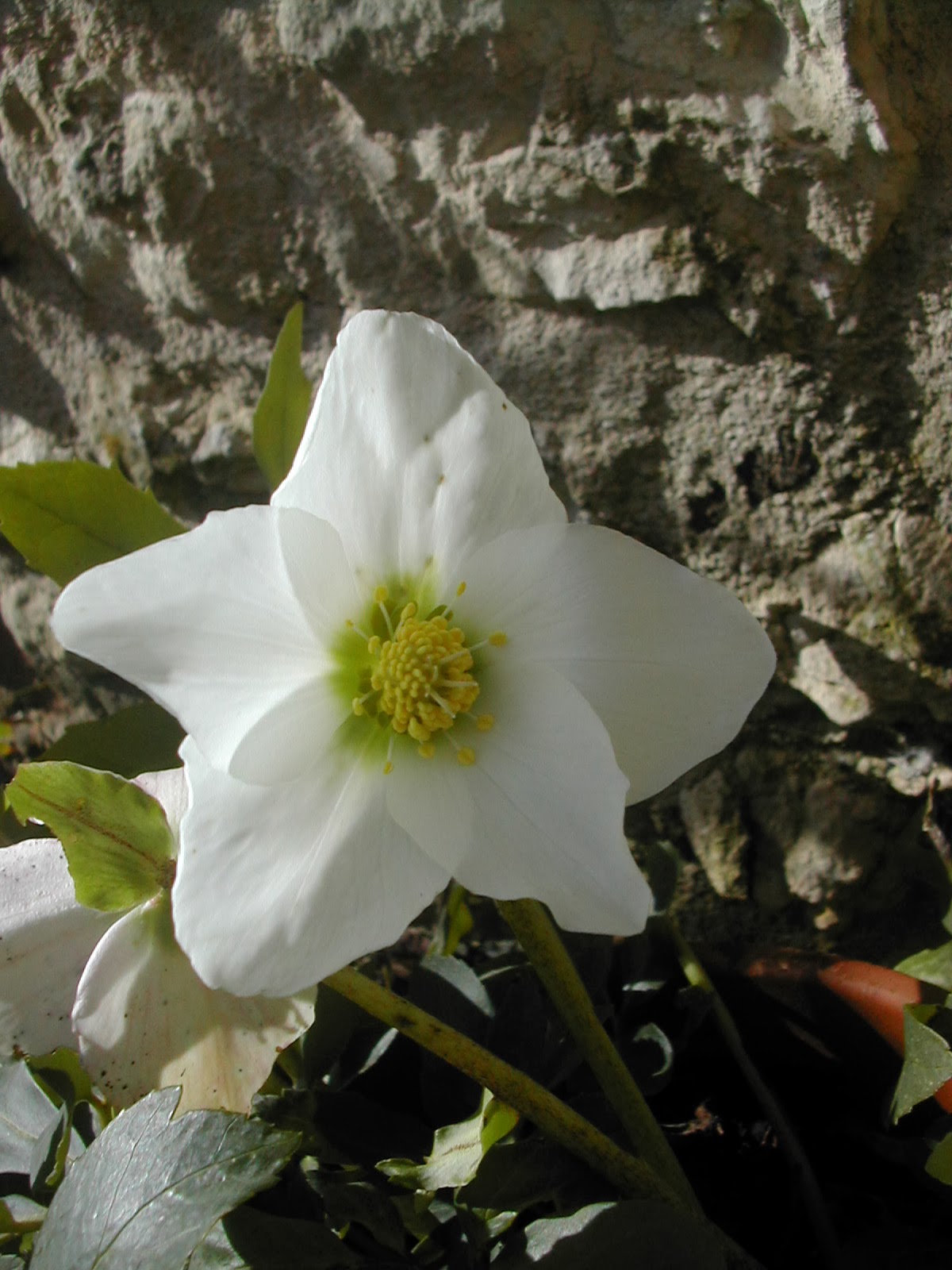
Helleborus niger
 also called Christmas rose

here together with a glass object
made by my Great Grandfather around 1900
 *
*
 *
Choisya ternata
*
Choisya ternata

...a small
genus of aromatic
evergreen shrubs in the
rue family,
Rutaceae.
Members of the genus are commonly known as
Mexican orange or
mock orange
due to the similarity of their flowers with those of the closely related
orange,
both in shape and scent.
They are
native to southern North America, from Arizona, New Mexico,
Texas and south through most of Mexico.
In its generic name
Humboldt and
Bonpland
honoured Swiss botanist
Jacques Denis Choisy (1799-1859).

An evergreen shrub with slender, glossy, dark green leaves,
and clusters
of fragrant, pink-tinged white flowers in late spring.
But at our place
- depending on the temperatures -
it also starts flowering during the winter months.
just coming into flower - here and there......
*
Choisya is ideal for the back or middle of a mixed border,
and in hot summers it
may flower again in late summer, even in a mild winter.
It can also be grown in partial shade
as an attractive foliage plant.
Although it's fully hardy,
the leaves
may be damaged by exposure to strong winds or frost.
*
***
*