
Fashion and costume
have always formed an integral part of society, class and individualism.
The Diary 2011 from the National Gallery, London,
explores a variety of trends depicted by a selection of the world's finest artists.
For this week:
Anthony van Dyck, 1599-1641

The Balbi Children - Anthony van Dyck, about 1625-7, detail

Van Dyck used Genoa as his base during his six-year stay in Italy
and spent most of 1625-7 in the city enjoying great success as a portraitist.
This work, traditionally entitled 'The Balbi Children'
because it belonged to the 18th-Century collector, Costantino Balbi,
shows three young aristocratic Genoese children who remain unidentified.
It has been suggested that they are members of the Franchi family,
whose arms contained a black crow,
but there is no documentary evidence to support this claim.

Portrait of Marchesa Balbi, 1622-1627
The National Gallery of Art, Washington DC, USA
Self-portrait, 1613-14
He painted this Self-portrait when he was only 14 or 15 years old.
How amazing and what a talent!
*
Sir Anthony van Dyck - 22 March 1599 - 9 December 1641 -
was a Flemish Baroque artist who became the leading court painter in England.
He is most famous for his prtraits of King Charles I of England and Scotland
and his family and court, painted with a relaxed elegance that was to be the
dominant influence on English portrait-painting for the next 150 years.
He also painted biblical and mythological subjects,
displayed outstanding facility as a draftsman,
and was important innovator in watercolour and etching.

'Portrait du Roi Charles I a la chasse, vers 1635' Louvre, Paris
In France before 1738;
purchased by Louis XVI. from Madame Du Barry in 1775
*
Antoon van Dyck (his Flemish name) was born to prosperous parents in Antwerp.
His talent was evident very early, and he was studying painting with Hendrick van Balen by 1609,
and became an independent painter around 1615, setting up a workshop with
his even younger friend Jan Brueghel the Younger.
By the age of fifteen he was already a highly accomplished artist,
as his Self-portrait, 1613-14 shows. He was admitted to the
Antwerp painters' Guild of Saint Luke as a free master by February 1618.
Within a few years he was to be the chief assistant to the dominant master of Antwerp,
and the whole of Northern Europe, Peter Paul Rubens, who made much us of
sub-contracted artists as well as his own large workshop.
His influence on the young artist was immense;
Rubens referred to the nineteen-year-old van Dyck as "the best of my pupils".
The origins and exact nature of their relationship are unclear; it has been
speculated that Van Dyck was a pupil of Rubens from about 1613,
as even his early work shows little trace of van Balen's style,
but there is no clear evidence for this. At the same time the dominance of Rubens
in the small and declining city of Antwerp probably explains why,
despite his periodic returns to the city, Van Dyck spent most of his career abroad.
In 1620, in Ruben's contract for the major commission for the ceiling
of the Jesuit church at Antwerp, van Dyck is specified as one of the "discipelen"
who was to execute the paintings to Ruben's designs.
*
In 1620, at the instigation of the Duke of Buckingham,
van Dyck went to England for the first time
where he worked for King James I & VI, receiving 100 Pounds Sterling.
It was in London in the collection of Earl of Arundel that he first saw the work of Titian,
whose use of colour and subtle modeling of form would prove transformational,
offering a new stylistic language that would enrich
the compositional lessons learned from Rubens.

The more intimate, but still elegant style
he developed in England, ca 1638
*
In 1620 - After about four months in England he returned to Flanders,
but moved on in late 1621 to Italy, were he remained for 6 years,
studying the Italian masters and beginning his career as a successful portraitist.
He was already presenting himself as a figure of consequence,
annoying the rather bohemian Northern artist's colony in Rome,
says Bellori, by appearing with "the pomp of Xeuxis... his behaviour was
that of a nobleman rather than an ordinary person, and he shown in rich garments;
since he was accustomed in the circle of Rubens to noblemen,
and being naturally of elevated mind, and anxious to make himself distinguished,
he therefore wore - as well as silks - a hat with feathers and brooches,
gold chains across his chest, and was accompanied by servants.
Italy:
He was mostly based in Genoa, although he also travelled extensively to other cities,
and stayed for some time in Palermo in Sicily. For the Genoese aristocracy,
then in a final flush of prosperity, he developed a full-length portrait style,
drawing on Veronese and Titian as well as Rubens' style from his own period in Genoa,
where extremely tall but graceful figures look down on the viewer with great hauteur.

Genoan hauteur from the Lomelli family, 1623
In 1627, van Dyck went back to Antwerp where he remained for five years,
painting more affable portraits which still made his Flemish patrons look as stylish as possible.
He was evidently very charming to his patrons, and, like Rubens,
well able to mix in aristocratic and court circles,
which added to his ability to obtain commissions.
London:
Van Dyck had remained in touch with the English court,
and had helped King Charles' agents in their search for pictures.
In April 1632, he returned to London, and was taken under the wing of the court immediately,
being knighted in July and at the same time receiving a pension of £ 200 per year,
in the grant of which he was described as principalle Paynter in ordinary to their majesties.

Children of King Charles I

Children of Charles I - a few years later in 1637
(the "little one" no longer needs a rostrum)
Windsor Castle, Royal Collection, UK(the "little one" no longer needs a rostrum)
King Charles I was the most passionate and generous collector of art among the British monarchs,
and saw art as a way of promoting his grandiose view of the monarchy.
He was extremely short (less than five feet tall)
and presented challenges to a portraitist.

This triple portrait of King Charles I
was sent to Rome for Bernini to model a bust on
During his time in London, van Dyck was provided with a house on the river Blackfriars,
then just outside the City and hence avoiding the monopoly of the Painters Guild.
A suite of rooms in Eltham Palace, no longer used by the Royal family,
was also provided as a country retreat.
His Blackfriars studio was frequently visited by the King and Queen
(later a special causeway was built to ease their access),
who hardly sat for another painter whilst van Dyck lived.

Self Portrait With a Sunflower
showing the gold collar and medal King Charles I gave him in 1633.
The sunflower may represent the king, or royal patronage.
*

James Stuart (1612-1655), Duke of Richmond and Lennox
by Anthony van Dyck, ca. 1634-35, Oil on canvas (216 x 127 cm)
Marquand Collection, Gift of Henry G. Marquand, 1889Metropolitan Museum of Art, New York
James Stuart, fourth duke of Lennox,
was made first duke of Richmond by his cousin, Charles I, in 1641,
he married Mary Villiers, daughter of the king's favorite, the duke of Buckingham.
It has been suggested plausibly that van Dyck painted this canvas in London just before
or after his stay in the Netherlands (early 1634 to early 1635)
in order to celebrate Stuart's investiture into the Order of the Garter in November 1633.
The order's insignia are conspicuously displayed
amidst van Dyck's masteful description of luxurious materials:
the silver star on the mantle; the red and gold Jewel,
or lesser George, on the green ribbon (to which the greyhound seems to refer);
and the garter itself, behind the bow at the duke's left knee.
The composition recalls Titian's famous Charles V with a Hound,
which was then in Charles I's collection.

A preparatory sketch of the figure
and a sheet bearing two studies of the dog are in the British Museum, London

George Villiers, 2nd Duke of Buckingham
and His Brother Lord Francis Villiers, 1635
Windsor Castle, Royal Collection
Princess Henriette Maria of France
Queen consort of England, 1632
Royal Collection, Windsor Castle, UK
*****
But now back to the 21th Century
and La Pouyette....in France...


Honeysuckle - Lonicera Caprifoliceae
on the back wall of the house, next to the window of the laundry room,
filling the whole area with an infatuating perfume!
Lonicera japonica
Evergreen twining climber. Height up to 10 meters (70ft), frost hardy.
*
another Honeysuckle on our front field...

Lonicera japonica 'Halliana' - not evergreen, also frost hardy,
already in full flower, nearly 2 month earlier as 'normal'!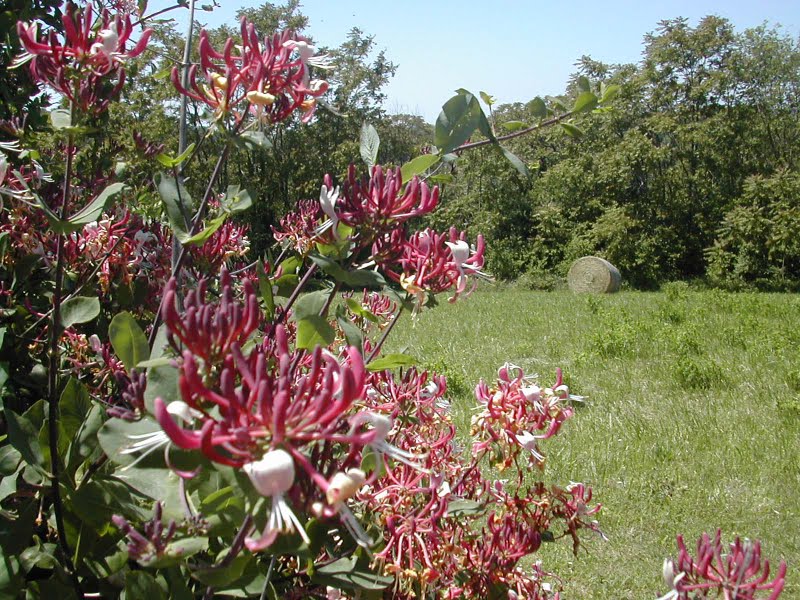
*
and.... 
.....all these old linen, washing - dyeing - experimenting......
and the colors don't even suit me....!


Bonne Semaine
P.S. by the way....
dyeing old linen...
making slowly progress...

trying to get all kind of beige, gray and natural colors


more about...soon in a future post
about dyeing linen: see also www.trouvais.com - Trish

